BLS and ACLS for Operation Theatre & Anesthesia Teams: A Practical Guide for Doctors
An operation theatre can look calm one minute and become a critical emergency scene the next. A patient may develop severe bradycardia, tachycardia, cardiac arrest, airway problems or another cardiopulmonary emergency during induction, surgery or recovery. For this reason, ACLS for anesthesia doctors is not simply about having a certificate. It is about being prepared to respond as part of a coordinated medical team when seconds matter.
For young doctors in Pakistan, BLS and ACLS training can also become important when applying for hospital jobs, postgraduate induction programs, changing departments or preparing for a career abroad. However, whether a certificate is mandatory depends on the specific hospital, employer, licensing body or training program.
Why BLS and ACLS Matter in the Operation Theatre
Operation theatre teams are trained to anticipate complications, but not every emergency can be predicted. Anesthesia doctors, surgeons, nurses and other theatre staff may need to respond together when a patient’s condition suddenly deteriorates.
This is where structured resuscitation training becomes useful. BLS focuses on the immediate response: recognising a life-threatening event, starting high-quality CPR, using an AED when appropriate and supporting ventilation. ACLS takes the response further by teaching systematic assessment, rhythm recognition, resuscitation algorithms, emergency medications and team dynamics.
BLS: The Foundation
- High-quality CPR
- Early AED use
- Basic airway and ventilation support
- Recognition of cardiac arrest
- Effective communication during resuscitation
ACLS: The Advanced Response
- Adult cardiac arrest algorithms
- Bradycardia and tachycardia management
- ECG rhythm recognition
- Emergency cardiovascular pharmacology
- Team leadership and megacode scenarios
The American Heart Association describes BLS as training in prompt recognition and response to life-threatening emergencies, including high-quality CPR and early AED use. Its ACLS course is designed for healthcare professionals who participate in managing cardiac arrest, stroke and other cardiopulmonary emergencies.
Why ACLS for Anesthesia Doctors Is Important
Anesthesia doctors work in an environment where airway, breathing, circulation, monitoring and medication decisions can change rapidly. A patient may be stable before induction and then develop a serious cardiovascular or respiratory problem within minutes.
That is why ACLS for anesthesia doctors can be particularly relevant. ACLS gives healthcare professionals a structured approach to adult cardiopulmonary emergencies rather than relying only on memory or improvisation.
The goal is not to turn every anesthesia doctor into a cardiologist. The goal is to make sure the team can recognise a deteriorating patient, start appropriate resuscitation, communicate clearly and follow the current emergency algorithm.
Imagine a young anesthesia resident assisting during an elective procedure. Shortly after induction, the monitor shows a sudden change in heart rate and the patient’s blood pressure falls.
The resident has several things to consider at the same time: Is there a pulse? Is the rhythm organised? Is the patient becoming unstable? Could the problem be related to airway, ventilation, oxygenation, medication or a cardiovascular event?
BLS provides the foundation for immediate resuscitation if cardiac arrest occurs. ACLS adds a structured approach to rhythm assessment, emergency interventions and team communication.
Real Operation Theatre Scenarios Where BLS and ACLS Skills Matter
Reading an algorithm in a textbook is different from using your knowledge when a patient suddenly deteriorates. Scenario-based practice helps doctors understand how the pieces fit together.
The monitor changes suddenly and the patient becomes unresponsive. The team confirms the emergency and begins resuscitation.
In this situation, high-quality CPR and rapid coordination are critical. The team needs clear roles, effective communication and appropriate use of the available resuscitation equipment.
ACLS training adds the advanced framework for rhythm assessment, appropriate interventions and coordinated team-based resuscitation.
During a procedure, the monitor shows a very fast rhythm and the patient’s blood pressure is falling. The team must rapidly assess the patient rather than simply reacting to the number on the monitor.
ACLS training teaches doctors to approach tachyarrhythmias systematically, including consideration of whether the patient is stable or unstable and what rhythm is present.
A patient develops a very slow heart rate during a procedure. The anesthesia team has to assess the patient’s clinical condition, identify possible causes and determine the appropriate response.
A structured ACLS approach helps the team avoid treating the monitor number in isolation and instead assess the patient, rhythm and clinical stability together.
Emergencies become harder when several people are speaking at the same time. One person is preparing equipment, another is checking the monitor, another is performing CPR and another is communicating with the surgical team.
ACLS training includes team dynamics and megacode practice so participants can become more comfortable with role allocation, closed-loop communication and coordinated emergency response.
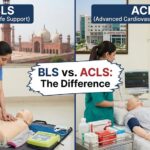
BLS vs ACLS for Operation Theatre and Anesthesia Teams
| Area | BLS | ACLS |
|---|---|---|
| Main purpose | Immediate lifesaving response and high-quality CPR | Advanced management of adult cardiopulmonary emergencies |
| CPR | Core skill | Builds on high-quality BLS CPR |
| AED/defibrillation | Early AED use | Integrated into cardiac arrest management |
| ECG rhythms | Basic emergency recognition | More detailed rhythm assessment |
| Emergency medications | Not the main focus | Major component of ACLS training |
| Team leadership | Basic team response | Advanced team dynamics and megacode scenarios |
For many healthcare professionals, BLS should be treated as the foundation rather than an alternative to ACLS. The American Heart Association states that ACLS builds on BLS skills and expects participants to be proficient in BLS.
You can learn more about the AHA BLS Certification Course in Lahore if you need to establish or renew your BLS foundation.
What Do Doctors Learn in an ACLS Course?
A good ACLS course is not simply a lecture about cardiac arrest. Participants practise applying resuscitation principles to simulated adult emergencies.
1. Systematic patient assessment
Doctors learn to approach an emergency systematically instead of jumping between unrelated interventions.
2. Cardiac arrest management
ACLS covers the structured management of adult cardiac arrest and the importance of continuous, high-quality CPR.
3. ECG rhythm recognition
Rhythm recognition is an important part of ACLS preparation. Doctors should become familiar with clinically important rhythms and understand how rhythm findings fit into the overall patient assessment.
4. Bradycardia and tachycardia
ACLS includes structured approaches to adult bradycardia and tachycardia. This can be especially relevant to doctors working around surgery, anesthesia, emergency medicine and critical care.
5. Emergency pharmacology
Participants learn the role of emergency medications within the current ACLS algorithms. The exact drug recommendations and doses should always be learned from the current official AHA course materials and used according to the applicable clinical protocol.
6. Team dynamics and megacode practice
A cardiac emergency is rarely managed by one person. ACLS therefore includes team-based scenarios where participants practise communication, role allocation, clinical decision-making and leadership.
If ECG interpretation and emergency pharmacology are areas you want to revise before ACLS, you can explore the ECG & Pharmacology Course .
Why Teamwork Matters During an Operation Theatre Emergency
In a real emergency, knowing the algorithm is only one part of the job. The team also needs to work together.
- One person may lead the resuscitation.
- Another team member may perform chest compressions.
- Another may manage equipment and medications.
- Another may monitor rhythm and vital signs.
- Someone should communicate clearly with the wider theatre team.
Clear communication reduces confusion. Team members should understand their roles and communicate important actions clearly. This is one reason hands-on simulation is valuable during resuscitation training.
If you want to understand the type of practical training environment used for these courses, visit the AHA training simulator page .
Is BLS or ACLS Mandatory for Doctors?
This is one of the most common questions young doctors ask before applying for a job or induction. The honest answer is: it depends on the position and organisation.
BLS and ACLS should not be described as universally mandatory for every doctor. Individual hospitals, employers, postgraduate programs, licensing authorities and international healthcare organisations may set their own requirements.
However, a valid BLS or ACLS provider card may be specifically requested for certain clinical roles, especially positions involving emergency response, critical care, surgery, anesthesia or other areas where clinicians may participate in cardiopulmonary emergencies.
Why BLS and ACLS Can Matter for Pakistani Doctors
For a young doctor, certification is not only about the day you attend the course. It can also become part of your professional documentation.
For a New Hospital Job
Some employers ask for current life-support certification as part of their recruitment or onboarding requirements. Having the relevant credential ready can make your application easier to document.
For Induction Applications
If your target program asks for BLS or ACLS, arrange the course early rather than discovering the requirement immediately before the submission deadline.
For Doctors Changing Departments
Moving from a lower-acuity role into anesthesia, emergency medicine, ICU or another acute-care environment may bring different training expectations.
For Doctors Planning to Work Abroad
International employers and institutions may ask healthcare professionals for current life-support credentials. Requirements differ by country and employer, so always check the exact documentation required for your target position.
The American Heart Association states that successful completion of the ACLS course results in an ACLS course completion card, and its current ACLS course information specifically includes healthcare professionals who manage or participate in cardiopulmonary emergencies, including personnel in surgery.
How to Prepare for ACLS as an Anesthesia Doctor
If you have your ACLS course coming up, do not wait until the evening before the class to start reviewing.
A Simple ACLS Preparation Checklist
- Revise BLS first. Make sure you are comfortable with high-quality CPR, AED use and basic resuscitation response.
- Review ECG basics. Revise the common rhythms you are likely to encounter during ACLS scenarios.
- Understand stable vs unstable patients. Learn to connect the rhythm with the patient’s clinical condition.
- Review emergency pharmacology. Use the current official AHA course material rather than relying on old notes or outdated doses.
- Practise speaking clearly. In a megacode, communication is part of the exercise. Practise giving and confirming instructions.
- Practise scenarios. Try to think through emergencies instead of memorising isolated facts.
The aim is not to memorise every page of the course manual. Focus on understanding the logic of the algorithms and becoming comfortable applying them in a simulated emergency.
AHA BLS and ACLS Courses in Lahore
If you are looking for an AHA BLS and ACLS course in Lahore , check the current course information and registration options before booking.
The current published September and October 2026 schedule lists AHA BLS sessions at Allama Iqbal Medical College and CMH Lahore, while ACLS sessions are listed at CMH Lahore. The published ACLS schedule also states that participants should have a valid/current BLS Provider Card before attending ACLS.
Because course dates and seat availability can change, confirm the latest date, venue, fees and registration details before travelling or making payment.
AHA ACLS Course
For healthcare professionals who need advanced cardiovascular life-support training.
View AHA ACLS Certification CourseAHA BLS Course
Build the CPR, AED and basic emergency-response foundation needed before advanced training.
View AHA BLS Certification CourseBLS + ACLS Combo
A practical option for doctors who need both BLS and ACLS and want to plan both certifications together.
View BLS & ACLS Combo CourseCheck the Schedule
Choose a course date that fits your hospital duty, induction deadline or job joining date.
View Latest Lahore ScheduleDoctors travelling from Rawalpindi or Islamabad should confirm the exact venue and available batch before planning travel to Lahore. If your hospital or employer offers a suitable authorised AHA Training Center closer to you, compare the course requirements and dates before registering.
Frequently Asked Questions About ACLS for Anesthesia Doctors
1. Why is ACLS important for anesthesia doctors?
Anesthesia teams may participate in the management of sudden cardiopulmonary emergencies in and around the operation theatre. ACLS provides a structured framework for adult cardiac arrest, bradycardia, tachycardia, stroke and other cardiovascular emergencies, building on BLS skills.
2. Is BLS required before ACLS?
The AHA expects ACLS participants to be proficient in BLS skills. Specific Training Centers may require a current BLS Provider card. The current Lahore schedule published on this website states that participants should have a valid/current BLS Provider Card before attending ACLS.
3. Is ACLS mandatory for every anesthesia doctor?
No universal rule applies to every doctor. Requirements depend on the hospital, employer, licensing authority or training program. Check the exact requirements of the position you are applying for.
4. Is BLS enough for an operation theatre doctor?
BLS is the foundation for immediate CPR and basic emergency response, but some clinical positions may require or prefer ACLS as well. If your role involves participating in adult cardiopulmonary emergencies, check whether your employer specifically requires ACLS.
5. What does ACLS cover for anesthesia and OT teams?
ACLS covers systematic assessment, high-quality CPR, adult cardiac arrest, rhythm recognition, bradycardia, tachycardia, emergency cardiovascular pharmacology, team dynamics and simulated resuscitation scenarios.
6. Should I take an ECG course before ACLS?
If you are not comfortable recognising common cardiac rhythms or reviewing emergency pharmacology, additional preparation can be useful. An ECG and Pharmacology preparation course can help you refresh these areas before ACLS.
7. Can BLS and ACLS help when applying for jobs abroad?
They can be useful credentials when an international employer or institution asks for life-support certification. However, acceptance and requirements vary by country, employer and licensing body. Always check the specific requirements for the position and country you are applying to.
8. How long is an AHA BLS or ACLS course completion card valid?
The American Heart Association states that BLS and ACLS course completion cards are valid for two years. Always check the validity dates on your current card and the renewal requirements applicable to your situation.
9. Where can doctors check the latest AHA BLS and ACLS schedule in Lahore?
You can check the latest AHA BLS and ACLS schedule in Lahore before registering. Dates and seat availability can change, so confirm the details with the registration team.
Preparing for Your Next Hospital Job, Induction or Career Move?
Do not wait until the application deadline to discover that your BLS or ACLS certificate has expired or that your target employer requires a specific provider credential. Check the course requirements, choose the appropriate training and plan your certification around your clinical duties.
Explore AHA ACLS Course Explore AHA BLS Course Check Latest Schedule
Want course updates?
Follow the
AHA BLS & ACLS WhatsApp Channel
for course announcements and schedule updates.
Training information: AHA BLS & ACLS Lahore Online facilitates registration with authorized American Heart Association Training Centers. It is not itself a direct AHA Training Center. Certificates are issued by the respective authorized Training Center after successful completion of the applicable course.