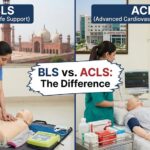

Do I need BLS or ACLS?
If you are a medical student, a nurse, or a young doctor in Lahore preparing for your house job, you have likely asked this question.
While both certifications come from the American Heart Association (AHA) and deal with saving lives, they are designed for different levels of expertise and different scenarios. Picking the wrong one can waste your time and money.
At ahablslahore.online, we want to ensure you sign up for the course that matches your career stage. Here is the simple breakdown of Basic Life Support (BLS) versus Advanced Cardiovascular Life Support (ACLS).
1. What is BLS (Basic Life Support)?
The Foundation of Resuscitation
Think of BLS as the foundation of a house. You cannot build anything else without it. BLS focuses on keeping oxygenated blood flowing to the brain and heart until advanced help arrives.
- Who is it for? Everyone in healthcare (Doctors, Nurses, Dentists, Pharmacists, Paramedics) and even laypeople.
- What do you learn? High-quality CPR, using an AED (Defibrillator), and relieving choking in adults, children, and infants.
- Prerequisites: None.
- Key Focus: Immediate, hands-on physical interventions.
2. What is ACLS (Advanced Cardiovascular Life Support)?
The Next Level of Care
ACLS is for healthcare professionals who specifically direct or participate in the management of cardiopulmonary arrest. It assumes you already know BLS perfectly.
- Who is it for? Doctors (especially in ER, ICU, CCU), Senior Nurses, and Paramedics.
- What do you learn? Reading ECG rhythms, administering emergency drugs (like Epinephrine, Amiodarone), intubation/airway management, and leading a “Code Blue” team.
- Prerequisites: You must have a valid AHA BLS certification to take ACLS.
- Key Focus: Clinical algorithms, drug dosages, and team leadership.
3. The Major Differences at a Glance
| Feature | BLS (Basic Life Support) | ACLS (Advanced Cardiac Life Support) |
| Primary Goal | Sustain life via CPR & AED | Stabilize patient via drugs & advanced tools |
| Equipment | Hands, Pocket Mask, AED | ECG Monitor, IV/IO access, Meds, Intubation |
| Difficulty | Moderate (Physical stamina required) | High (Requires medical knowledge & rhythm interpretation) |
| Duration | ~4-5 Hours | ~2 Days (approx. 12-16 hours) |
4. Which One Should You Take?
- If you are a medical student (MBBS/BDS): Start with BLS. It is usually required before your clinical rotations or graduation. You generally do not need ACLS until your house job or residency.
- If you are applying for the USMLE/PLAB/Gulf Jobs: BLS is the mandatory minimum. ACLS is a huge “plus” for your CV, but you cannot take it without passing BLS first.
- If you are a general public member (Teacher, Gym Coach): Stick to BLS (or Heartsaver CPR). ACLS involves medical pharmacology that isn’t relevant outside a hospital.
Conclusion: Start with the Basics
You cannot run before you can walk. Even the best cardiac surgeon in the world cannot save a patient if high-quality CPR isn’t started immediately.
Whether you need the foundational skills of BLS or the advanced algorithms of ACLS, ahablslahore.online is your trusted partner for AHA-certified training in Lahore.
Not sure which course is right for you? Message us, and we’ll guide you!