What Is BLS Certification? A Simple Guide for Doctors in Pakistan
What is BLS certification? BLS certification is proof that a healthcare professional has completed training in Basic Life Support and can respond appropriately to life-threatening emergencies such as cardiac arrest, respiratory arrest and airway obstruction.
For young doctors in Pakistan, BLS is more than another certificate to add to a CV. It can become an important part of preparing for a hospital job, induction program, emergency department role or an overseas healthcare career.
If you are a house officer, medical officer, FCPS applicant or a doctor planning to move abroad, this guide explains what BLS certification means, what you learn, why it matters, how it differs from ACLS and when you may need both.
- What Is BLS Certification?
- Why Is BLS Certification Important?
- What Do You Learn in a BLS Course?
- A Common Situation for a Young Doctor
- Is BLS Certification Mandatory for Doctors?
- BLS vs ACLS: What Is the Difference?
- Who Should Get BLS Certification?
- Why BLS Matters for Doctors Planning to Work Abroad
- BLS Certification in Lahore, Rawalpindi and Islamabad
- AHA BLS and ACLS Course Fees
- How to Choose a BLS Course
- Frequently Asked Questions
- Start Your BLS Certification
What Is BLS Certification?
BLS stands for Basic Life Support. BLS certification is a healthcare training credential that demonstrates that a participant has learned and successfully completed the required Basic Life Support training.
BLS focuses on the first critical actions needed when a patient suffers a cardiac arrest or another life-threatening emergency. The training includes high-quality CPR, use of an automated external defibrillator (AED), appropriate ventilation and response to airway obstruction.
The American Heart Association’s BLS Provider Course is designed for healthcare professionals and trained first responders who may need to provide emergency care. After successfully completing the course requirements, participants receive an AHA BLS Provider Course Completion Card, which is valid for two years.
For a doctor, this means BLS is not simply about knowing how to perform CPR from a textbook. The purpose is to build practical skills that can be used when a patient suddenly collapses in a ward, emergency department, clinic, operating theatre or other healthcare setting.
Why Is BLS Certification Important for Doctors?
Imagine you are working a normal shift. A patient suddenly becomes unresponsive. The monitor changes, the patient is not breathing normally and the team starts calling for help.
This is not the moment to open your phone and search for the CPR steps.
You need to recognize the emergency, start appropriate CPR, use an AED or defibrillator when indicated, communicate with the team and continue effective resuscitation while more advanced help arrives.
That is where BLS training becomes valuable.
- It teaches structured emergency response.
- It develops practical CPR skills.
- It teaches appropriate AED use.
- It covers basic airway and ventilation support.
- It prepares healthcare professionals to respond as part of a resuscitation team.
- It provides a recognized course completion credential for professional requirements where applicable.
The American Heart Association’s current adult BLS guidance emphasizes recognition of cardiac arrest, activation of emergency response, high-quality CPR, AED use and management of respiratory arrest and foreign-body airway obstruction.
A Common Situation for a Young Pakistani Doctor
Imagine Dr. Ahmed has completed his house job in Lahore. He is applying for an induction program while also considering a hospital job and an overseas career pathway.
His CV already includes his medical degree, house job and registration. He has his experience certificates ready. While reviewing job and training requirements, he notices that a current BLS certificate is requested by one of the positions.
He now has two choices: leave the requirement until the last minute or complete the certification early and keep the valid card ready with his professional documents.
For doctors who are regularly applying for positions, completing relevant certifications before an application deadline can make the process much easier.
This situation is particularly common among doctors who are:
- Applying for FCPS or other induction programs
- Changing hospitals or departments
- Applying for medical officer positions
- Moving toward ER, ICU, anesthesia or critical care work
- Preparing documents for overseas employment
- Building their professional profile after house job
What Do You Learn in a BLS Certification Course?
A proper BLS course is practical. The goal is not simply to memorize a few CPR points. Healthcare professionals need to demonstrate the skills required by the course.
Depending on the course format and current AHA requirements, BLS training covers core areas such as:
1. High-Quality CPR
You learn the key principles of effective CPR and how to perform chest compressions appropriately during cardiac arrest.
2. AED Use
An automated external defibrillator can play a critical role in sudden cardiac arrest. BLS training teaches healthcare professionals how to integrate AED use into resuscitation.
3. Recognition of Cardiac Arrest
Early recognition matters. The course teaches participants how to respond when a patient is unresponsive and not breathing normally.
4. Ventilation and Basic Airway Support
BLS training also covers appropriate ventilation and basic airway-related emergency management.
5. Choking and Airway Obstruction
Healthcare professionals may also encounter patients with foreign-body airway obstruction. BLS includes appropriate response principles for these emergencies.
6. Team-Based Resuscitation
Cardiac arrest management is rarely a one-person task in a hospital. Communication, role allocation and coordinated action are important parts of effective emergency response.
Is BLS Certification Mandatory for Doctors?
There is no single rule that makes BLS mandatory for every doctor in every job. Requirements can vary according to the hospital, department, employer, induction program, healthcare system and country.
However, BLS certification is commonly requested for healthcare roles where the professional may need to respond to a medical emergency. Some hospitals and employers may specifically ask for a current BLS or ACLS completion card.
For a young doctor, the practical approach is simple: if the job advertisement, hospital, induction program or overseas employer lists BLS as a requirement, make sure you have the appropriate current certification before the deadline.
Always check the exact requirements of the hospital, induction program, employer or licensing authority you are applying to.
BLS vs ACLS: What Is the Difference?
One of the most common questions doctors ask is: Should I take BLS or ACLS?
The answer depends on your role.
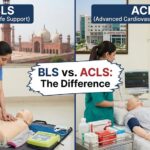
| Feature | BLS | ACLS |
|---|---|---|
| Full form | Basic Life Support | Advanced Cardiovascular Life Support |
| Main focus | CPR, AED, basic emergency response | Advanced management of cardiovascular emergencies |
| Best suited for | Healthcare professionals and trained responders | Healthcare professionals involved in advanced emergency care |
| Key areas | CPR, AED, ventilation, choking | Cardiac arrest, ECG/rhythm recognition, medications, stroke, ACS and team dynamics |
| Level | Foundation | Advanced |
| Typical career relevance | Hospital jobs, clinical roles and emergency response requirements | ER, ICU, critical care, anesthesia, medicine and other advanced emergency roles |
The AHA describes ACLS as training for healthcare professionals who direct or participate in the management of cardiac arrest, stroke and other cardiopulmonary emergencies. Current ACLS course requirements also expect participants to be proficient in BLS skills, ECG interpretation, ACLS pharmacology and bag-mask ventilation.
That is why BLS should not be viewed as an alternative to ACLS. In many career situations, the two certifications complement each other.
Who Should Get BLS Certification?
BLS is particularly relevant for healthcare professionals and trainees who may be involved in patient care and emergency response.
For young doctors in Pakistan, BLS can be useful if you are:
- A house officer completing or recently completing house job
- A medical officer applying for a new position
- Preparing for an induction program
- Planning an ER or ICU career
- Working in anesthesia, medicine, cardiology or critical care
- Applying for jobs at hospitals that require current BLS certification
- Preparing for an overseas healthcare career
- Looking to strengthen your emergency care skills
If your next role involves advanced management of cardiac emergencies, you should also consider ACLS rather than stopping at BLS.
Why BLS Matters for Doctors Planning to Work Abroad
Many Pakistani doctors plan their careers around opportunities in the UK, Gulf countries, Australia, Ireland and other international healthcare systems.
The exact certification requirements vary between countries, employers and licensing pathways. Therefore, a BLS certificate should not be treated as a universal immigration or licensing requirement.
But having current resuscitation training can still be professionally useful, especially when applying for clinical positions where emergency response skills are relevant.
If an employer specifically asks for an AHA BLS or ACLS completion card, make sure you complete the exact course requested rather than assuming that any generic CPR certificate will be accepted.
BLS Certification in Lahore, Rawalpindi and Islamabad
If you are searching for BLS certification in Lahore, AHA BLS course Lahore, BLS course Rawalpindi or BLS certification Islamabad, check the training date, course type, certification provider and current requirements before registering.
AHA BLS & ACLS Lahore provides information about AHA BLS and ACLS training options for healthcare professionals. The website also publishes the latest available course schedule.
Doctors travelling from Rawalpindi and Islamabad can check the available Lahore dates and plan their visit around their clinical duties. Always confirm the current venue and seat availability before travelling.
Check the latest AHA BLS & ACLS Schedule
AHA BLS and ACLS Course Fees in Lahore
The currently listed fees are:
BLS + ACLS Combo
Discounted package for doctors who need both certifications.
View Combo CourseCourse fees, dates and availability can change, so confirm the latest information before making payment or travelling.
Why Consider BLS + ACLS Together?
If you already know that your target job or induction program requires both certifications, taking BLS and ACLS together can be a practical option.
The current discounted combo is Rs. 56,000, compared with Rs. 58,000 when the two courses are booked separately at their current listed fees.
This can be particularly useful for doctors preparing for a job switch, induction application or clinical role where both basic and advanced life-support training may be relevant.
See the AHA BLS + ACLS Combo Course
Why ACLS Preparation Requires More Than Memorizing Algorithms
Doctors sometimes complete BLS and immediately move toward ACLS without preparing their ECG interpretation and pharmacology knowledge.
That can make ACLS preparation more difficult.
The AHA identifies ECG recognition and pharmacology as important competencies for ACLS participants. If you feel weak in these areas, additional preparation can help.
Explore the ECG & Pharmacology Course
You can also learn more about the practical training environment through the training simulator.
How to Choose the Right BLS Course
Before registering for a BLS course, do not look only at the price. Check the following:
- Course provider: Confirm what organization issues the completion card.
- Course type: Make sure you are registering for the BLS course appropriate for your professional role.
- Hands-on training: Practical skills are an important part of healthcare resuscitation training.
- Current certification: Check the validity period and renewal requirements.
- Employer requirements: If your hospital or employer has specified a particular certification, follow its requirements.
- Course date: Avoid waiting until the last day before an induction or job application deadline.
- Verification: Keep your course completion information safely with your professional documents.
How Long Is an AHA BLS Certification Valid?
An AHA BLS Provider Course Completion Card is generally valid for two years. AHA also states that course completion cards are valid through the end of the month in which the card was issued.
Do not assume that an old certificate will remain acceptable forever. If an employer or induction program asks for a current BLS certificate, check the card’s validity before submitting your application.
What Is the Difference Between a BLS Certificate and a Generic CPR Certificate?
People often use the words CPR certificate and BLS certificate interchangeably, but they are not always the same thing.
CPR is a core component of BLS. However, a healthcare professional may need a specific BLS course completion card rather than a general public CPR participation certificate.
If your employer specifically asks for AHA BLS, complete the appropriate AHA BLS course instead of assuming that any CPR certificate will meet the requirement.
Frequently Asked Questions About BLS Certification
What is BLS certification?
BLS certification is a healthcare training credential showing that a participant has successfully completed Basic Life Support training. The training focuses on CPR, AED use, ventilation and response to life-threatening emergencies.
What does BLS stand for?
BLS stands for Basic Life Support.
Is BLS certification mandatory for every doctor?
No. There is no single requirement that makes BLS mandatory for every doctor. Requirements vary by employer, hospital, department, induction program and country. However, some clinical positions specifically require a current BLS certificate.
How long is AHA BLS certification valid?
An AHA BLS Provider Course Completion Card is generally valid for two years.
Is BLS enough for an ICU or emergency doctor?
BLS provides the foundation for emergency response, but doctors working in areas such as emergency medicine, intensive care or critical care may also need ACLS depending on their employer and role.
Do I need BLS before ACLS?
ACLS participants must be proficient in current BLS skills. The AHA’s current ACLS requirements also include ECG interpretation, ACLS pharmacology and bag-mask ventilation. Check the specific prerequisites of your training center before booking.
How much is AHA BLS certification in Lahore?
The currently listed AHA BLS fee is Rs. 22,000. Confirm the latest fee, date and venue before registration.
How much is AHA ACLS certification in Lahore?
The currently listed AHA ACLS fee is Rs. 36,000. Confirm the latest course details before registration.
Is there a BLS and ACLS combo package?
Yes. The currently listed discounted BLS + ACLS combo fee is Rs. 56,000.
Can doctors from Rawalpindi and Islamabad take BLS training in Lahore?
Yes. Doctors from Rawalpindi and Islamabad can check the available Lahore course dates and travel for training. Always confirm the exact venue and availability before travelling.
Is AHA BLS accepted internationally?
AHA BLS is a recognized healthcare resuscitation training credential, but acceptance depends on the employer, institution, licensing authority and country. If you are applying abroad, check the exact certification requirement of your target organization.
Where can I check the latest BLS and ACLS schedule?
You can check the latest AHA BLS and ACLS schedule or contact the training team for current dates and availability.
Final Takeaway: Should You Get BLS Certification?
If you are a young doctor preparing for your next hospital job, induction program or international career, BLS is a useful certification to have when it is required for your role.
More importantly, BLS gives you practical training for situations where seconds matter. A patient can deteriorate unexpectedly in a ward, emergency department, clinic or operating theatre. Knowing what to do in those first moments can make a real difference.
Think of BLS as the foundation of emergency response. If your career path involves advanced cardiac emergencies, build on that foundation with ACLS.
For doctors in Lahore, Rawalpindi and Islamabad, the best time to complete a required certification is before the application deadline—not after you discover that the certificate is missing from your documents.
Ready to Start Your AHA BLS Certification?
If you are preparing for an induction program, changing jobs or planning your next step in healthcare, check the latest BLS and ACLS course dates before your deadline.
Book AHA BLS Book AHA ACLS Get BLS + ACLS Combo View ScheduleYou can also follow the training updates on our WhatsApp Channel.
Join WhatsApp ChannelNote: Course fees, dates, venues and requirements can change. Always confirm the latest course information and the requirements of your employer, induction program or licensing authority before registration.