
BLS for MBBS Students in Lahore: When Should You Take It?
A practical, scenario-based guide for young Pakistani doctors planning their house job, induction, or career abroad.
Picture this: It is 3:00 AM during an intense emergency medicine rotation at a crowded public hospital in Lahore. You are the house officer on duty. Suddenly, a patient in cardiac arrest is rushed through the doors. The family is panicked, the room is chaotic, and every second counts. Your senior turns to you and says, “Start high-quality CPR right now!”
Do you know the exact chest compression depth? Are you fully confident in your hand placement, compression-to-ventilation ratio, and advanced airway coordination? More importantly, when the time comes to apply for a competitive residency induction program or pack your bags for the UK, US, or Middle East, do you have the internationally recognized paperwork to back up your hands-on life support skills?
For young medical professionals navigating the early steps of their careers in Lahore, Rawalpindi, and Islamabad, timing is everything. Securing an American Heart Association (AHA) certified BLS for MBBS students Lahore is no longer just a checkbox on a resume—it is the foundational gateway to safe clinical practice and global career progression.
Why Are BLS and ACLS Mandatory Across Pakistan?
As young Pakistani doctors, your career paths usually lead to one of three major goals: entering a government residency program via the Central Induction Program (CIP), switching to a high-paying private healthcare system, or clearing international licensing pathways like USMLE, PLAB/UKMLA, or the Irish Medical Council exams.
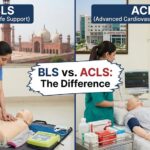
No matter which path you select, modern medical frameworks require structured, standard training. A simple theoretical understanding from your textbooks will not suffice during real-world medical crises. That is why learning Basic Life Support (BLS) and Advanced Cardiovascular Life Support (ACLS) has become universally mandatory:
- Postgraduate Induction Edge: Competitive systems like the Punjab Residency Program (PRP) place a massive premium on validated, practical emergency qualifications. Having these credentials on your portfolio can clear administrative roadblocks during document verification.
- International Medical Licensing: If you are moving abroad, international medical boards require active clinical certification. An authentic AHA card proves you meet global resuscitation standards.
- Real-World Clinical Confidence: Walking into a ward knowing you can independently operate an Automated External Defibrillator (AED) or confidently manage a sudden malignant arrhythmia entirely transforms your day-to-day patient management.
If you want to step up from standard chest compressions to treating complex cardiac emergencies, it is highly recommended to pair your primary life support training with an AHA ACLS certification course in Lahore to confidently handle strokes, acute coronary syndromes, and complex rhythms.
When is the Perfect Time to Take BLS for MBBS Students in Lahore?
Because an AHA certificate remains valid for exactly two years, timing your course strategically ensures it remains active right when you need it most. Let us look at the three most common clinical scenarios to see when you should book your seat.
Scenario A: The Final Year Student Eyeing Internships & Electives
If you are currently finishing your final year of MBBS, your schedule is undoubtedly packed with clinical rotations and ward tests. However, if you plan to apply for clinical electives in the United States or the UK immediately after your final professional exams, you should take your BLS course right before your final exams or during the immediate study break. This gives you a valid certificate to submit alongside your hospital applications abroad without delaying your visa processing.
Scenario B: The House Officer Preparing for Central Induction
For most young doctors, the ideal window opens midway through your house job or roughly two months before the postgraduate induction application portal opens. Completing your life support training during this period ensures that your certificates are fully active throughout your interviews, onboarding, and the critical first year of your residency training program.
Scenario C: The Job-Switcher or Career Career-Enlarger
Are you currently working a grueling medical officer job in a peripheral town and planning to switch to a premier private hospital in Lahore, Islamabad, or Rawalpindi? Or perhaps you are step-studying at home and need to fill gaps in your clinical portfolio? For you, the answer is immediately. Do not wait for a job opening to appear. Having an active, verified emergency certification on your CV instantly separates your application from hundreds of regular medical graduates.
To further sharpen your clinical edge before entering a busy emergency ward or intensive care unit, consider completing the focused ECG & Pharmacology course to master cardiac monitoring analysis and emergency medication calculations seamlessly.
Mark Your Calendar: August 2026 Lahore Training Schedule
Planning your clinical schedule requires precision, especially when juggling night shifts, calls, and study plans. To accommodate busy house officers and students from across Punjab and the capital territory, we have lined up multiple weekend and weekday sessions at our premium training center.
Review the upcoming course dates for August 2026 and select the session that fits your schedule best:
| Month | Available Training Dates | Day of the Week |
|---|---|---|
| August 2026 | August 7, 2026 | Friday |
| August 8, 2026 | Saturday | |
| August 10, 2026 | Monday | |
| August 17, 2026 | Monday | |
| August 22, 2026 | Saturday | |
| August 24, 2026 | Monday | |
| August 29, 2026 | Saturday | |
| August 31, 2026 | Monday |
Note: Registration closes early for weekend slots due to strict student-to-manikin ratio guidelines established by the AHA. Book your slot well in advance to avoid missing out.
Investment & Value: Fee Structure & The Smart Combo Option
We understand that as a house officer or medical student, balancing financial budgets is just as important as managing clinical schedules. We maintain fully transparent pricing for all our international standard certification courses, ensuring there are zero hidden administration costs:
- 📌 AHA BLS Fee: Rs. 22,000
- 📌 AHA ACLS Fee: Rs. 36,000
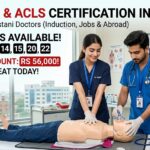
- 🎁 Exclusive Professional Combo Package: Rs. 56,000 (Save Rs. 2,000 instantly!)
Opting for the AHA BLS & ACLS combo course in Lahore is the smartest strategic choice for your professional portfolio. Most major clinical networks and international agencies require both credentials simultaneously. Completing them in a combined training format saves you valuable study time, provides a significant financial discount, and satisfies your portfolio needs in one comprehensive session.
Frequently Asked Questions (FAQs)
Q1: Can I take the AHA BLS course during my final year of MBBS?
Yes, final year MBBS students can absolutely take the course, especially if they are planning to apply for electives abroad or want to build a strong clinical portfolio before starting their house job.
Q2: How long is the validity of the AHA BLS and ACLS certificates?
Both American Heart Association (AHA) BLS and ACLS certifications are internationally valid for exactly 2 years from the date of issuance, after which you need a recertification course.
Q3: Is BLS mandatory for postgraduate residency induction in Pakistan?
Yes, major central induction programs (like the Punjab Residency Program / PRP) and top-tier private hospitals in Lahore, Islamabad, and Rawalpindi award crucial merit points or strictly require valid resuscitation certifications during the application process.
Q4: What is the fee structure for AHA courses at your center?
The individual AHA BLS fee is Rs. 22,000, and the AHA ACLS fee is Rs. 36,000. However, you can save money by choosing our Combo Discounted Package for just Rs. 56,000.