
Table of Contents
- Introduction: The Reality for Young Pakistani Doctors
- Why Do You Need AHA Certification? Three Common Scenarios
- What Exactly Are BLS and ACLS?
- Training Locations: Lahore, Rawalpindi, and Islamabad
- Fee Structure: Transparent and Simple
- What to Expect on the Day of Your Course
- Frequently Asked Questions (FAQs)
- Conclusion
Introduction: The Reality for Young Pakistani Doctors
Imagine this common scenario: Dr. Hamza has just wrapped up his grueling one-year house job. He is exhausted but ambitious. He has a solid plan for his future. He wants to either move to the UK to work in the NHS, secure a spot in a highly competitive induction program, or grab a well-paying job at a top-tier private setup like Doctors Hospital in Lahore or Shifa in Islamabad.
He polishes his CV and feels proud of his clinical rotations. But when he starts filling out applications, he hits a massive roadblock. Every single portal has a mandatory upload section: Valid AHA BLS and ACLS Provider Cards.
Dr. Hamza has a basic first aid certificate from a local ward workshop he attended back in medical college, but the portal clearly states: ‘Only American Heart Association (AHA) certifications are accepted.’
This is a reality for thousands of young Pakistani doctors today. If you are reading this, you are probably in the exact same boat. You are looking for a reliable, fast, and authentic way to get your AHA BLS and ACLS certification in Lahore, Rawalpindi, or Islamabad. In this guide, we break down why you need these courses, what you will actually learn, the exact fees involved, and how you can register without the usual headache.
Why Do You Need AHA Certification? Three Common Scenarios
Scenario 1: Going Abroad (PLAB, USMLE, DHA)
If your ultimate goal is to fly out of Pakistan to build your career, your locally issued hospital CPR cards hold zero value. Whether you are aiming for the UK (via PLAB/GMC), the USA (via USMLE), or the Middle East (DHA, HAAD, Prometric), the global standard is the American Heart Association. Foreign hospitals want to know that if a patient goes into sudden cardiac arrest, you know exactly what to do according to the latest international algorithms. They simply don’t have the time to train you from scratch. Having your BLS and ACLS ready shows you meet strict international medical standards.
Scenario 2: The Induction Race
Getting into a postgraduate training program (FCPS, MS, MD) is tough. The competition is incredibly fierce across the country. While your academic marks matter most, your overall portfolio is often the deciding factor in central induction programs. When interviewers see that you are already an AHA-certified ACLS provider, they see a doctor who is ready to handle ward emergencies safely from day one. More importantly, once your induction starts, you will be forced to get these certifications anyway. Getting it done now saves you the extreme stress of taking a tough 2-day course while managing 36-hour continuous ward calls.
Scenario 3: Switching Jobs to Top Private Hospitals
Maybe you want to save up some money before your major exams, so you apply for a Medical Officer position at a major private hospital in Lahore, Rawalpindi, or Islamabad. Big private setups handle VIP patients and strictly follow international healthcare protocols (like JCI accreditation). They cannot afford to hire a doctor for the ER, ICU, or even general wards who does not hold a valid AHA ACLS card. It is a baseline hiring requirement.
What Exactly Are BLS and ACLS?
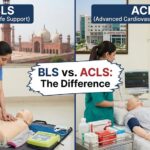
Basic Life Support (BLS)
BLS is the core foundation of saving lives. It is a hands-on, one-day course where you learn high-quality CPR, how to properly use an Automated External Defibrillator (AED), and how to relieve choking in adults, children, and infants. You will practice extensively on high-tech mannequins that give real-time feedback on how deep and fast you are pushing.
If you need this foundational step, you can book your AHA BLS Certification Course in Lahore right now to secure the earliest date.
Advanced Cardiovascular Life Support (ACLS)
If BLS is the foundation, ACLS is the entire building. This is a rigorous 2-day course meant specifically for healthcare providers who either direct or participate in the management of cardiopulmonary emergencies. You will learn how to run a “Code Blue” as a team leader. You will read live ECG rhythms on a monitor, administer emergency cardiac medications, and manage severe conditions like cardiac arrest, stroke, and acute coronary syndromes.
The biggest hurdle in ACLS is the Megacode—a simulated high-stress emergency where you must make split-second decisions. To pass smoothly, you need a very strong grip on ECGs and emergency pharmacology. If you feel weak in this area, we highly recommend taking our targeted ECG & Pharmacology Course beforehand to brush up your skills.
Ready for the advanced step? Secure your seat for the AHA ACLS Certification Course in Lahore.
Training Locations: Lahore, Rawalpindi, and Islamabad
We know that doctors work on exhausting, unpredictable schedules. Finding the right training center at the right time is half the battle.
Lahore: As the massive medical training hub of Punjab, Lahore offers the most frequent classes. Whether your hospital is near Jail Road, Johar Town, or DHA, getting to a certified training site is easy and convenient.
Islamabad & Rawalpindi: For doctors working in the twin cities, traveling all the way to Lahore isn’t always practical. We ensure that AHA courses are regularly scheduled in Islamabad and Rawalpindi to cater to the massive medical community working in federal, private, and military hospitals in the region.
Fee Structure: Transparent and Simple
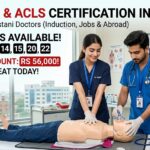
Budget is a big concern for young doctors who are just starting out. We keep our pricing clear, upfront, and with no hidden charges. The fee includes your original AHA provider manuals, the hands-on training sessions, the exam fees, and your official eCard which is valid globally for 2 years.
Current AHA Certification Fees:
- AHA BLS Fee: Rs 22,000
- AHA ACLS Fee: Rs 35,000
- Combo Discounted Fee: Rs 55,000
Pro Tip: Almost every single doctor who needs BLS will eventually need ACLS. If you book them separately, it will cost you Rs 57,000. By booking our AHA BLS & ACLS Combo Course Discounted Package, you save money and instantly secure your dates for both courses without any future hassle.
What to Expect on the Day of Your Course
Let’s remove the fear of the unknown. Many doctors feel anxious about failing the AHA exams, especially the ACLS Megacode. Here is exactly how a typical training day goes:
1. Practice While Watching
The American Heart Association uses a highly effective “practice while watching” format. You won’t just sit and listen to boring slideshows. You will watch a detailed video showing the exact right way to perform a skill, and then you will immediately practice it on a mannequin.
2. Hands-on Skill Stations
You will be divided into small groups. An expert instructor will guide you through different stations. One station might focus entirely on airway management—inserting advanced airways and using bag-mask devices correctly. Another station will focus entirely on the AED and defibrillator. You get to physically handle all the equipment, which builds real muscle memory.
3. Team Dynamics
In real life, you never save a patient entirely alone. You work with nurses, technicians, and other doctors. The ACLS course heavily grades you on your communication skills. You will learn how to assign roles, speak clearly, and “close the loop” when giving verbal medical orders.
4. The Final Exam
At the end of the course, you will face two tests. First is the written multiple-choice exam. It is open-resource, meaning you can open and look at your AHA provider manual during the test. Second is the skills test (the Megacode). You will be given a random scenario, like a patient coming in with ventricular fibrillation, and you must lead your team to manage the patient correctly. If you studied your manual, you will pass without a problem.
Frequently Asked Questions (FAQs)
Conclusion
Your medical career is a continuous journey of learning and improving. Securing your authentic AHA certifications is not just about ticking a mandatory box on a job application; it is about genuinely gaining the confidence and skills to save a human life when seconds matter the most. Do not let an expired or unverified local CPR card delay your career goals.
Whether you are applying for an induction program, moving abroad, or joining a top hospital, make sure you get certified the right way.
Ready to Secure Your Spot?
Don’t wait until the last minute. Seats for our upcoming sessions fill up fast due to high demand across major cities.
Register for AHA Certification Today